Publications
2026
Characterizing two nanobodies for SMAD4. FEBS Letters (2026).
2025
Development of a functional assay for the characterisation of SMAD4 variants from the French haemorrhagic hereditary telangiectasia cohort. Journal of Medical Genetics (2025): jmg-2025-110797.
Rare but specific: 5-bp composite motifs define SMAD binding in BMP signaling. BMC Biology (2025), 23(1).
Navigating Drug Discovery for Myhre Syndrome: The Complexity of a Multisystemic Rare Disease. American Journal of Medical Genetics Part C: Seminars in Medical Genetics (2025), 199(4): 290-305.
2024
TGF-β and RAS jointly unmask primed enhancers to drive metastasis. Cell (2024), 187(22): 6182-6199.e29.
De Novo Engineering of Pd-Metalloproteins and Their Use as Intracellular Catalysts. JACS Au (2024), 4(7): 2630-2639.
AI is a viable alternative to high throughput screening: a 318-target study. Scientific Reports (2024), 14(1).
TPPU_DSF: A Web Application to Calculate Thermodynamic Parameters Using DSF Data. Journal of Molecular Biology (2024), 436(17): 168519.
Overcoming challenges in structural biology with integrative approaches and nanobody-derived technologies. Current Opinion in Structural Biology (2024), 84: 102764.
2023
Structural basis of a redox-dependent conformational switch that regulates the stress kinase p38α. Nature Communications (2023), 14(1).
Characterization of p38α autophosphorylation inhibitors that target the non-canonical activation pathway. Nature Communications (2023), 14(1).
2022
Conformational ensemble of the TNF-derived peptide solnatide in solution. Computational and Structural Biotechnology Journal (2022), 20: 2082-2090.
HTSDSF Explorer, A Novel Tool to Analyze High-throughput DSF Screenings. Journal of Molecular Biology (2022), 434(11): 167372.
Molecular basis for DNA recognition by the maternal pioneer transcription factor FoxH1. Nature Communications (2022), 13(1).
Controlling oncogenic KRAS signaling pathways with a Palladium-responsive peptide. Communications Chemistry (2022), 5(1).
2020–2024
Structure-based design of a Cortistatin analogue with immunomodulatory activity in models of inflammatory bowel disease. Nature Communications (2021), 12(1).
Structures of the germline-specific Deadhead and thioredoxin T proteins from Drosophila melanogaster reveal unique features among thioredoxins. IUCrJ (2021), 8(2): 281-294.
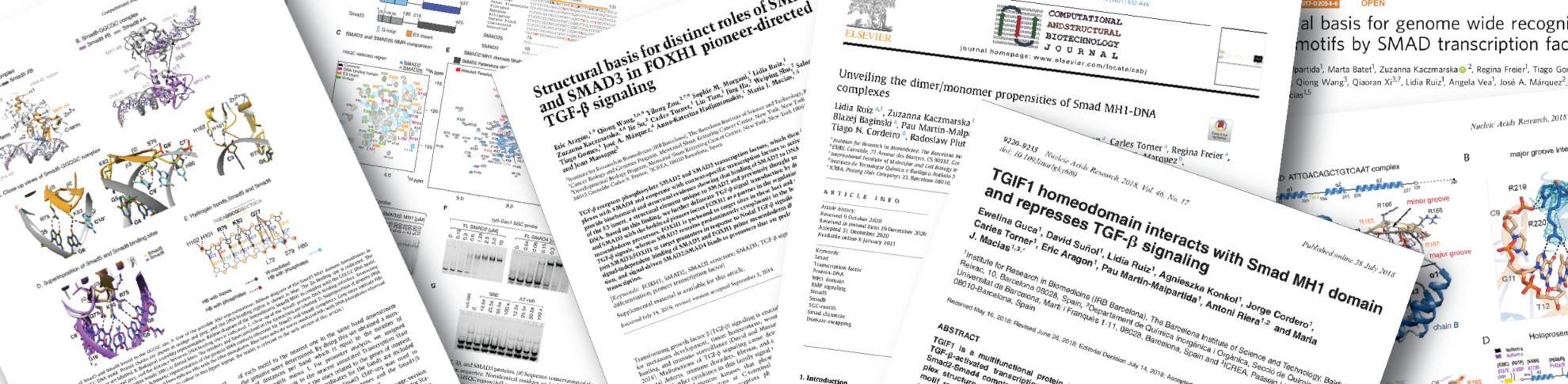
Unveiling the dimer/monomer propensities of Smad MH1-DNA complexes. Computational and Structural Biotechnology Journal (2021), 19: 632-646.
Conformational landscape of multidomain SMAD proteins. Computational and Structural Biotechnology Journal (2021), 19: 5210-5224.
Synthesis of Stable Cholesteryl–Polyethylene Glycol–Peptide Conjugates with Non-Disperse Polyethylene Glycol Lengths. ACS Omega (2020), 5(10): 5508-5519.
2015–2019
Binding site plasticity in viral PPxY Late domain recognition by the third WW domain of human NEDD4. Scientific Reports (2019), 9(1).
Structural basis for distinct roles of SMAD2 and SMAD3 in FOXH1 pioneer-directed TGF-β signaling. Genes & Development (2019), 33(21-22): 1506-1524.
TGIF1 homeodomain interacts with Smad MH1 domain and represses TGF-β signaling. Nucleic Acids Research (2018), 46(17): 9220-9235.
Structural basis for genome wide recognition of 5-bp GC motifs by SMAD transcription factors. Nature Communications (2017), 8(1).
The synthesis of an EDTA-like chelating peptidomimetic building block suitable for solid-phase peptide synthesis. Chemical Communications (2017), 53(17): 2634-2636.
ADP-ribose–derived nuclear ATP synthesis by NUDIX5 is required for chromatin remodeling. Science (2016), 352(6290): 1221-1225.
Peptide aromatic interactions modulated by fluorinated residues: Synthesis, structure and biological activity of Somatostatin analogs containing 3-(3′,5′difluorophenyl)-alanine. Scientific Reports (2016), 6(1).
Addition of HOBt improves the conversion of thioester‐Amine chemical ligation. Peptide Science (2015), 104(6): 693-702.
Preventing fibril formation of a protein by selective mutation. Proceedings of the National Academy of Sciences (2015), 112(44): 13549-13554.
Structural Analysis of the Pin1-CPEB1 interaction and its potential role in CPEB1 degradation. Scientific Reports (2015), 5(1).
Structural determinants of Smad function in TGF-β signaling. Trends in Biochemical Sciences (2015), 40(6): 296-308.
Structure of the N-terminal domain of the protein Expansion: an `Expansion' to the Smad MH2 fold. Acta Crystallographica Section D Biological Crystallography (2015), 71(4): 844-853.
2010–2014
A tetradecapeptide somatostatin dicarba-analog: Synthesis, structural impact and biological activity. Bioorganic & Medicinal Chemistry Letters (2014), 24(1): 103-107.
Folding kinetics of WW domains with the united residue force field for bridging microscopic motions and experimental measurements. Proceedings of the National Academy of Sciences (2014), 111(51): 18243-18248.
Identification of novel non-canonical RNA-binding sites in Gemin5 involved in internal initiation of translation. Nucleic Acids Research (2014), 42(9): 5742-5754.
RNA recognition and self-association of CPEB4 is mediated by its tandem RRM domains. Nucleic Acids Research (2014), 42(15): 10185-10195.
Structural Basis of the Activation and Degradation Mechanisms of the E3 Ubiquitin Ligase Nedd4L. Structure (2014), 22(10): 1446-1457.
Insights into Structure-Activity Relationships of Somatostatin Analogs Containing Mesitylalanine. Molecules (2013), 18(12): 14564-14584.
Structural Basis for the Versatile Interactions of Smad7 with Regulator WW Domains in TGF-β Pathways. Structure (2012), 20(10): 1726-1736.
The FF4 and FF5 Domains of Transcription Elongation Regulator 1 (TCERG1) Target Proteins to the Periphery of Speckles. Journal of Biological Chemistry (2012), 287(21): 17789-17800.
A Smad action turnover switch operated by WW domain readers of a phosphoserine code. Genes & Development (2011), 25(12): 1275-1288.
Fine‐tuning the π–π Aromatic Interactions in Peptides: Somatostatin Analogues Containing Mesityl Alanine. Angewandte Chemie (2011), 124(8): 1856-1861.
2005–2009
NMR Structural Studies on Human p190-A RhoGAPFF1 Revealed that Domain Phosphorylation by the PDGF-Receptor α Requires Its Previous Unfolding. Journal of Molecular Biology (2009), 389(2): 230-237.
Nuclear CDKs Drive Smad Transcriptional Activation and Turnover in BMP and TGF-β Pathways. Cell (2009), 139(4): 757-769.
Solution structure of the fourth FF domain of yeast Prp40 splicing factor. Proteins: Structure, Function, and Bioinformatics (2009), 77(4): 1000-1003.
Ubiquitin Ligase Nedd4L Targets Activated Smad2/3 to Limit TGF-β Signaling. Molecular Cell (2009), 36(3): 457-468.
Solution structure of the yeast URN1 splicing factor FF domain: Comparative analysis of charge distributions in FF domain structures—FFs and SURPs, two domains with a similar fold. Proteins: Structure, Function, and Bioinformatics (2008), 73(4): 1001-1009.
Myotonia-related mutations in the distal C-terminus of ClC-1 and ClC-0 chloride channels affect the structure of a poly-proline helix. Biochemical Journal (2007), 403(1): 79-87.
NMR Structural Studies of the ItchWW3 Domain Reveal that Phosphorylation at T30 Inhibits the Interaction with PPxY-Containing Ligands. Structure (2007), 15(4): 473-483.
Structural Characterization of a New Binding Motif and a Novel Binding Mode in Group 2 WW Domains. Journal of Molecular Biology (2007), 373(5): 1255-1268.
Structure of the Dimeric Exonuclease TREX1 in Complex with DNA Displays a Proline-rich Binding Site for WW Domains. Journal of Biological Chemistry (2007), 282(19): 14547-14557.
The Structure of Prp40 FF1 Domain and Its Interaction with the crn-TPR1 Motif of Clf1 Gives a New Insight into the Binding Mode of FF Domains. Journal of Biological Chemistry (2006), 281(1): 356-364.
Phosphorylation of either Ser16 or Thr30 does not disrupt the structure of the Itch E3 ubiquitin ligase third WW domain. Proteins: Structure, Function, and Bioinformatics (2005), 60(3): 558-560.
2000–2004
Structure and dynamics of the human pleckstrin DEP domain: Distinct molecular features of a novel DEP domain subfamily. Proteins: Structure, Function, and Bioinformatics (2004), 58(2): 354-366.
Solution Structure and Ligand Recognition of the WW Domain Pair of the Yeast Splicing Factor Prp40. Journal of Molecular Biology (2002), 324(4): 807-822.
Solution structures of the YAP65 WW domain and the variant L30 K in complex with the peptides GTPPPPYTVG, N-(n-octyl)-GPPPY and PLPPY and the application of peptide libraries reveal a minimal binding epitope. Journal of Molecular Biology (2001), 314(5): 1147-1156.
Synthesis and properties of oligonucleotides containing 8-bromo-2'-deoxyguanosine. Nucleosides, nucleotides & nucleic acids (2001), 20(3): 251-60.
Ultrafast folding of WW domains without structured aromatic clusters in the denatured state. Proceedings of the National Academy of Sciences (2001), 98(23): 13002-13007.
WW and SH3 domains, two different scaffolds to recognize proline‐rich ligands. FEBS Letters (2001), 513(1): 30-37.
Structural analysis of WW domains and design of a WW prototype. Nature structural biology (2000), 7(5): 375-9.
1995–1999
A novel NMR experiment for the sequential assignment of proline residues and proline stretches in 13C/15N-labeled proteins. Journal of Biomolecular NMR (1999), 13(4): 381-385.
The three-dimensional structure of the HRDC domain and implications for the Werner and Bloom syndrome proteins. Structure (1999), 7(12): 1557-1566.
Theoretical calculations, synthesis and base pairing properties of oligonucleotides containing 8-amino-2'-deoxyadenosine. Nucleic Acids Research (1999), 27(9): 1991-1998.
Specific interactions between the syntrophin PDZ domain and voltage-gated sodium channels. Nature Structural Biology (1998), 5(1): 19-24.
A small region in phosducin inhibits G‐protein βγ‐subunit function. The EMBO Journal (1997), 16(16): 4908-4915.
Automated NOESY interpretation with ambiguous distance restraints: the refined NMR solution structure of the pleckstrin homology domain from β-spectrin 1 1Edited by P. E. Wright. Journal of Molecular Biology (1997), 269(3): 408-422.
Structure of the WW domain of a kinase-associated protein complexed with a proline-rich peptide. Nature (1996), 382(6592): 646-649.
Structure of the binding site for inositol phosphates in a PH domain. The EMBO journal (1995), 14(19): 4676-85.
1990–1994
Structure of the pleckstrin homology domain from beta-spectrin. Nature (1994), 369(6482): 675-7.